

Our Magazine
The Rivalry: Rolex Daytona vs. Omega Speedmaster

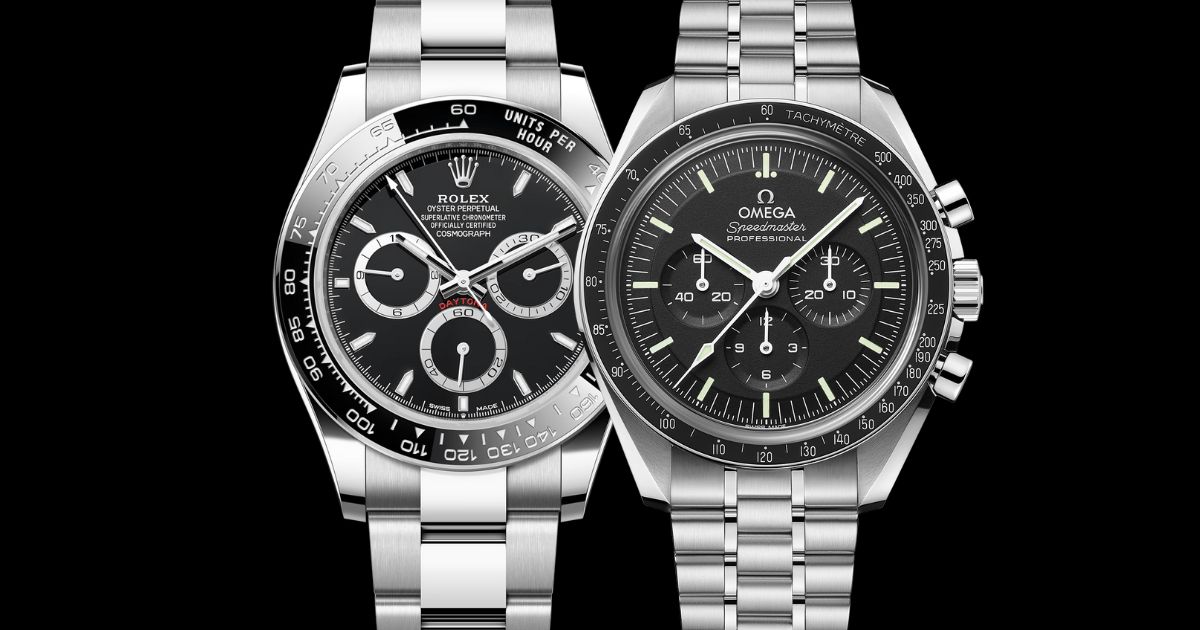
In the rarefied world of luxury watch collecting, few rivalries are as enduring, passionate, and significant as the one between the Rolex Cosmograph Daytona and the Omega Speedmaster. They are two of the most iconic chronographs ever made, each bearing a legacy that transcends mere timekeeping. To wear one is to make a statement about history, engineering, and personal identity. This isn’t just a comparison of specs; it’s a tale of two philosophies, two histories, and two paths to horological immortality.
The Crown’s Champion: Rolex Daytona
Born in 1963, the Rolex Daytona was designed for the high-octane world of motorsports. Its name, of course, comes from the Daytona International Speedway in Florida, a temple of speed. Initially, it was a watch for professional racing drivers, featuring a tachymetric scale on the bezel to calculate average speed.
The early days were not smooth. The first Daytonas used manually-wound movements, and sales were modest. The turning point came in the late 1980s with reference 16520, which housed Zenith’s legendary El Primero automatic movement, modified by Rolex. This transformed the Daytona into a self-winding powerhouse. Then, in 2000, Rolex unveiled its entirely in-house, automatic Caliber 4130—a masterpiece of simplification, reliability, and robustness.
What defines the Daytona spirit?
- Precision & Performance: It is the epitome of engineered excellence. Every component is built to stringent tolerances. It’s a chronograph built not just to measure time, but to endure.
- Luxury & Status: The Daytona, especially in precious metals or stainless steel with its iconic Oyster case and Cerachrom bezel, is a symbol of achievement. Its bracelet is famously comfortable, and its presence on the wrist is both substantial and refined.
- The “Paul Newman” Legacy: The actor and racing enthusiast’s personal Daytona (ref. 6239) created a mythos that propelled the model into the stratosphere of collectibility. The Daytona’s story is intertwined with celebrity, desire, and the auction block.
The Daytona is a watch of results. It is about winning, precision engineering, and a certain untouchable perfection. It is a chronograph polished to a brilliant sheen, ready for the podium.
The Dark Horse Hero: Omega Speedmaster
The Omega Speedmaster, introduced in 1957, took a different road. Originally designed as a sports and racing chronograph, its destiny was rewritten in the 1960s. After rigorous NASA testing for all manned space missions, it was “Flight-Qualified by NASA for All Manned Space Missions” in 1965. In 1969, it became the first watch worn on the Moon during the Apollo 11 mission, earning its eternal nickname: the “Moonwatch.”
While the Daytona sought earthly speed, the Speedmaster conquered the cosmos. Its manual-wound Caliber 321 (and later 861 and 3861) was chosen for its reliability in the vacuum of space. Its hesalite crystal could withstand massive temperature swings and was more shatter-resistant; if scratched, it could be polished. Its black dial with clear legibility and a robust case were tools for survival.
What defines the Speedmaster spirit?
- Exploration & Adventure: It represents human curiosity and courage. It’s a tool that has been to the Moon and back, a piece of history on your wrist.
- Tool-Watch Integrity: Despite updates, the “Moonwatch” remains fiercely true to its 1965 specification. It is manually wound, often features a hesalite crystal, and has a case profile that is instantly recognizable. It’s a mechanical companion for an adventure.
- A Story of Human Triumph: From the calm of Ed White’s first American spacewalk to the terror and triumph of Apollo 13, where it was used as a backup timer for a critical engine burn, the Speedmaster is woven into the fabric of 20th-century heroism.
The Speedmaster is a watch of journeys. It is about exploration, resilience, and a touch of nostalgic, mechanical purity. It bears its scratches as badges of honor.
The Head-to-Head: Philosophy on the Wrist
Putting them side by side reveals their core differences:
- Movement: The modern Daytona is a self-winding chronometer, a model of convenient, set-and-forget precision. The classic Speedmaster Professional is manually wound, connecting the wearer to the ritual of daily engagement with a piece of engineering history.
- Bezel: The Daytona’s bezel is tachymeter-only, fixed, and made of highly scratch-resistant ceramic. The Speedmaster’s is also a tachymeter but is traditionally made of anodized aluminum and, in most models, has a pulsometer scale on its outer track, nodding to its medical history.
- Crystal: Rolex uses a scratch-resistant sapphire crystal. The classic Speedmaster uses hesalite (acrylic), which is more shatter-resistant and authentic to its spaceflight heritage, though sapphire options now exist.
- Aesthetic: The Daytona is polished, luxurious, and dense. The Speedmaster is more tool-oriented, with brushed surfaces and a professional, utilitarian elegance.
Choosing Your Champion
So, which one is for you? The choice often reveals your personal horological values.
You might lean towards the Rolex Daytona if:
You appreciate peerless mechanical refinement and flawless finish. You see a watch as the pinnacle of luxury craftsmanship and a symbol of earned success. You want the reassurance of a superbly accurate, automatic movement and a watch that feels both solid and jewel-like.
You might lean towards the Omega Speedmaster if:
You are captivated by history and narrative. You value the tactile connection of winding your watch each morning and appreciate a tool-watch aesthetic with undeniable provenance. You want to wear a symbol of human exploration, a piece of engineering that helped write history.
Conclusion: Not a Winner, But a Legacy
Declaring a “winner” in the rivalry between the Rolex Daytona and the Omega Speedmaster misses the point. They are both champions in their own arenas. The Daytona won the race for cultural status and technical perfection in luxury sports chronography. The Speedmaster won the ultimate race—to the Moon—and captured the spirit of exploration.
For the collector, this rivalry is a gift. It represents two perfect, yet fundamentally different, expressions of what a chronograph can be. One is a chronograph perfected for Earth, a testament to human competition and luxury. The other is a chronograph proven beyond Earth, a testament to human ambition and resilience.
In the end, the greatest privilege is not having to choose, but understanding and appreciating the profound stories each one tells every time you glance at your wrist. One offers the glamour of the finish line; the other, the infinite promise of the stars.