

Our Magazine
From the Depths: The Naval Origins of Panerai

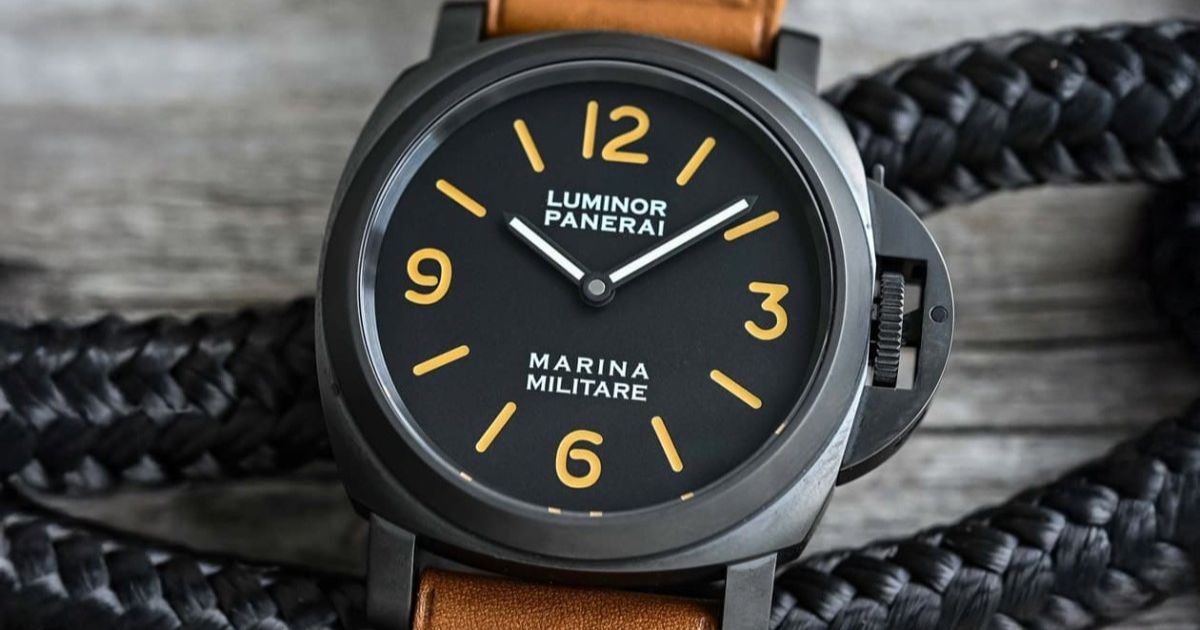
If you’ve spent any time in the world of luxury watches, you’ve felt the presence of Panerai. It’s a brand that commands attention with its bold, minimalist designs, its cushion-shaped cases, and an aura of rugged, instrumental purpose. But to see a Panerai Luminor or Radiomir today—often spotted on stylish wrists in cosmopolitan capitals—is to see only the polished surface. The true soul of these watches lies far from the glittering boulevards, in the silent, pressurised depths of the ocean, forged in partnership with the most demanding of clients: the frogman commandos of the Royal Italian Navy.
This is the story not of a watchmaker seeking a market, but of a specialised instrument supplier answering a call to action from the deep. To understand Panerai is to dive into its naval origins, a tale of innovation, darkness, and supreme legibility under pressure.
Florence, 1860: A Foundation of Precision
Our story begins not by the sea, but in the heart of Renaissance Italy, Florence. Here, in 1860, Giovanni Panerai opened a modest workshop, Orologeria Svizzera, a retailer and repairer of fine Swiss timepieces. More importantly, he also founded the city’s first watchmaking school. For decades, the Panerai family established themselves as purveyors of precision, working with the Italian Navy to supply optical and mechanical instruments. They were experts in measurement, a skill that would soon be pushed to its absolute limit.
The Birth of the “Radiomir”: A Solution Born of Darkness
By the early 20th century, naval warfare was evolving. The concept of underwater, human-guided attacks—using Gamma frogmen from the First World War and later the legendary Decima Flottiglia MAS—required equipment unlike any other. These commandos operated in pitch-black conditions: night dives, murky harbours, and the abyssal gloom beneath ships. Their standard-issue wristwatches were hopelessly inadequate.
The Navy needed a tool that could be read instantly, in total darkness, and withstand tremendous pressure and physical shock. In the 1930s, Panerai, under the leadership of Giovanni’s grandson, Guido, embarked on a secret project. Their revolutionary solution was two-fold.
First, the case. They started with a robust, cushion-shaped case from the Swiss manufacturer Rolex (known for its oyster case technology), but the innovation was in the wire lugs. These were not soldered on; they were forged from the same block of steel as the case, making them incredibly resistant to the violent pulls and twists of underwater gear.
Second, and most crucially, the dial. Panerai developed a radioluminescent paste using a zinc sulphide and copper compound, activated by radium-226. This material, patented in 1915 under the name “Radiomir,” glowed with an intensity never before seen. It was applied in large, simple shapes—numerals, hour markers, and the distinctive pencil hands—creating a dial of stark, breathtaking clarity. The philosophy was function above all: no unnecessary detail, no decoration, just essential information.
Thus, in 1936, the Ref. 3646 was born, the first “Panerai” watch. It was a radical, almost brutalist instrument. Its oversized 47mm case (massive for the time) housed a minimalist dial, a hand-wound movement, and that groundbreaking Radiomir paste. It was not a watch for telling the time; it was a watch for timing the mission.
Evolution Under Pressure: The “Luminor” Leap
The Radiomir was a success, but it had a flaw. The radium-based paste, while brilliantly effective, was highly radioactive and its luminosity degraded over time. After World War II, Panerai sought a safer, more stable solution.
In 1949, they patented a new substance: “Luminor.” This compound used tritium, a radioactive isotope of hydrogen, which was far less hazardous and offered a more consistent glow. With this new technology came an iconic design evolution. To protect the crown—a potential point of water intrusion—Panerai engineers created a revolutionary crown-protecting bridge. This hinged, semi-circular steel lever clamped the crown firmly against the case, guaranteeing water resistance. This patented device became the defining visual hallmark of the new line: the Luminor.
The Luminor 6152/1 series, delivered to the Navy in the early 1950s, represents the apex of the tool watch. With its crown guard, reinforced case, and Luminor dial, it was the ultimate expression of Panerai’s naval purpose. It was virtually indestructible and perfectly legible, a trusted companion for the men who performed some of the most perilous underwater operations in history.
The Great Slumber and The Phoenix from the Sea
For decades, these instruments were known only to a small circle of military personnel and a handful of civilian enthusiasts who stumbled upon them. Panerai remained a secret, a footnote in military history. Then, in the 1990s, the brand was revived for the public market.
The genius of the modern Panerai was not in abandoning its past, but in faithfully resurrecting it. The first models offered to the public—like the Luminor Marina (Ref. PAM 5218-201/A) in 1993—were near-replicas of the 1950s instruments. They understood that the power lay in the story, in the authenticity of the design language forged under extreme conditions.
The cushion case, the sandwich dial (where luminous material is layered between two dial plates for a distinctive, deep glow), the crown guard—these were not arbitrary aesthetic choices. They were DNA sequences coded with history. Wearing a Panerai was not just about telling time; it was about wearing a piece of that instrumental, heroic narrative on your wrist.
Legacy in Every Detail
Today, every modern Panerai whispers its origins. The Egiziano Garmin references pay homage to the oversized watches made for the Egyptian Navy. The Submersible line carries forward the professional diving mandate. The use of brushed steel, titanium, and other robust materials speaks to a tool-watch mentality. Even the simple act of telling time in the dark is a direct link to those first Radiomir commandos.
For the watch learner, Panerai offers a masterclass in how purpose shapes design. In an industry often focused on thinness, complication, and ornamentation, Panerai stands as a monolithic reminder of a different path: where clarity, robustness, and legibility are the highest forms of luxury. Its value is not in gemstones, but in its story; not in intricate engravings, but in the stark, purposeful lines drawn by necessity.
So, the next time you see that iconic crown guard, remember: it was not designed for a boutique window, but to seal a watch against the ocean’s depths. The luminous dial was not made for a dimly-lit restaurant, but for the black silence of a midnight dive. Panerai’s luxury is the luxury of pure, undiluted purpose—a purpose that was born, tested, and proven from the depths.