

Our Magazine
The Daytona Legacy: From Race Track to Wrist Legend

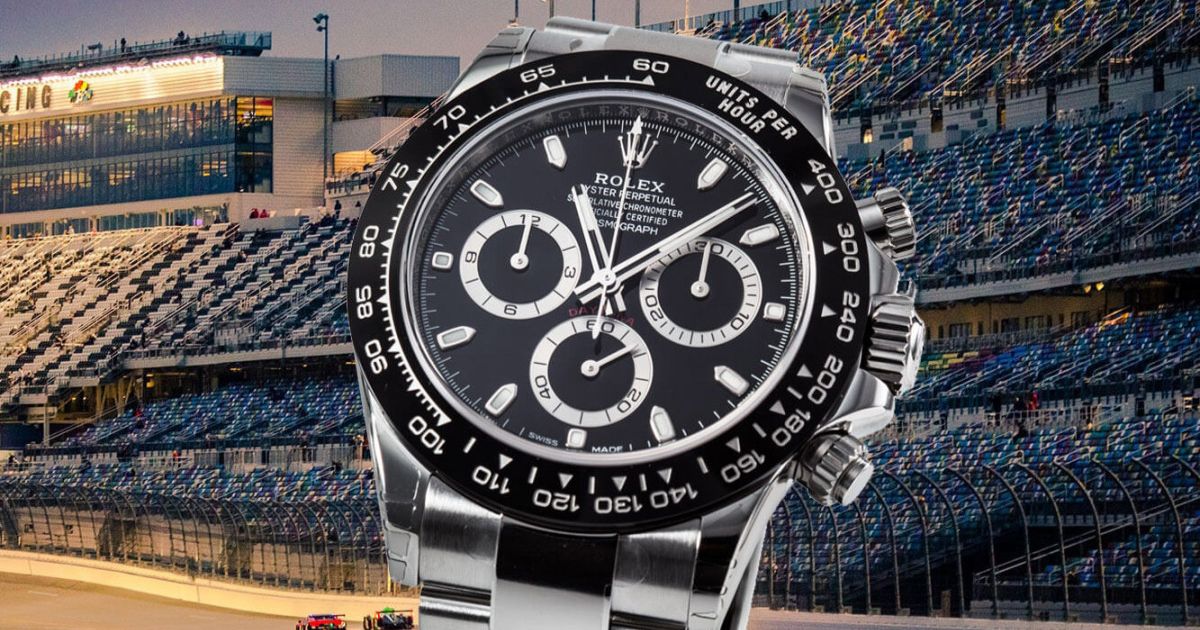
If you were to ask any watch enthusiast to name the most iconic chronograph ever created, the answer would almost certainly be unanimous: the Rolex Daytona. More than just a timepiece, the Daytona is a legend—a symbol of speed, precision, and an enduring connection to the golden age of motorsport. Its journey from a professional racing instrument to the pinnacle of wristwatch desire is a fascinating tale of evolution, celebrity, and timeless design. This is the legacy of the Daytona.
The Genesis: Born for The Track
The story begins not in Daytona, but on the racetracks of Europe and America in the early 1960s. Rolex, already famed for its robust Oyster case and precision, sought to create the ultimate driver’s chronograph. In 1963, they introduced the Cosmograph, reference 6239. It was a tool watch through and through, designed to measure elapsed time and average speed—critical calculations for any racing driver.
Its defining features were immediately established: a tachymeter scale on the bezel (not the dial, like earlier models), contrasting sub-dials for maximum legibility, and screw-down pushers for water resistance. The name “Daytona” was added to the dial a few years later, cementing its bond with the high-speed temple of American motorsport: the Daytona International Speedway in Florida. This partnership was a masterstroke, linking the watch indelibly with the glamour, danger, and innovation of auto racing.
The “Paul Newman” Phenomenon: From Underdog to Icon
Ironically, the Daytona was not an immediate commercial success. Its manual-wind Valjoux movement and busy dial were considered too specialized. For years, it lingered on jewellers’ shelves. Then came the twist that would forever alter its destiny.
A specific dial variant, with Art Deco-style numerals on the sub-dials and a contrasting seconds track, caught the eye of the most charismatic racing driver and Hollywood star of his era: Paul Newman. He was rarely seen without his exotic dial Daytona (reference 6239), a gift from his wife, Joanne Woodward. When a 1980s Italian magazine mistakenly dubbed it the “Paul Newman Daytona,” a legend was born. This model transformed from an overlooked variant into the most sought-after vintage watch on the planet. The “Paul Newman” effect taught the world that a watch’s story, its provenance and personality, could be as valuable as the mechanics inside.
The Zenith Era: A Revolution in Reliability
By the late 1980s, the watch world was in the midst of a quartz crisis, and mechanical watches were fighting back with innovation. Rolex’s answer for the Daytona was a game-changer. In 1988, they unveiled the reference 16520, the first automatic, self-winding Daytona.
At its heart was a modified version of the El Primero movement from Zenith—one of the finest, high-frequency automatic chronograph calibres ever made. This was a surprising and humble move from Rolex, acknowledging another’s excellence. This new Daytona was slimmer, more reliable, and finally offered the convenience of automatic winding. It bridged the gap between the vintage tool watch and the modern luxury icon, captivating a new generation of collectors and setting the stage for what was to come.
The Modern Legend: In-House Mastery
The true pinnacle of the Daytona’s technical evolution arrived in the year 2000 with reference 116520. For the first time, the Daytona was powered by a completely in-house engineered movement: Calibre 4130. This was a masterpiece of integration and efficiency. Rolex redesigned the chronograph from the ground up, making it more robust, easier to service, and equipped with a patented vertical clutch for smoother chronograph start-stop action and a Parachrom hairspring for anti-magnetism.
The modern Daytona became a paragon of chronometric precision. Its aesthetics were refined—the case grew more substantial, the dials even more crisp. The subsequent introduction of Cerachrom (ceramic) bezels in 2011, first in black and then in the now-mythic “Panda” and “Reverse Panda” combinations, made the watch virtually scratch-proof and its colours permanently vibrant.
Cultural Currency: Beyond the Track
While its roots are in racing, the Daytona’s appeal has long since accelerated past the finish line. It became a symbol of achieved success, a trophy on the wrist. Its association with Paul Newman was just the beginning. It has been worn by cultural icons from Roger Federer to Ellen DeGeneres, further cementing its status as a cross-cultural icon of excellence.
Yet, its most significant cultural phenomenon in the 21st century is its sheer unobtainability. The modern stainless steel Daytona, particularly with the ceramic bezel, is one of the most elusive watches in the world, with waiting lists stretching for years. This has created a unique aura—a watch that is defined not just by its ownership, but also by the patience and dedication required to acquire it.
A Legacy in Motion
Today, the Daytona is more than the sum of its parts. It is a living history of 20th-century watchmaking: from manual-wind specialist tool, to celebrity-accidental icon, to a masterpiece of in-house mechanical innovation. Its design language is so potent that it has remained fundamentally unchanged for over six decades—a testament to its perfect initial conception.
For the language learner and watch enthusiast, the Daytona’s story is rich with vocabulary: from tachymeter and chronograph to provenance, calibre, and heritage. It teaches us that value is not just in materials, but in narrative, innovation, and cultural resonance.
The Daytona’s engine is no longer measured just in beats per hour, but in the enduring speed of its legacy. It started life timing laps on the track, and now it sets the pace for an entire industry. It is, and likely always will be, the definitive wrist legend.