

Our Magazine
Automatic Watches 101: What They Are and Why They Matter

If you’ve ever been captivated by the smooth, silent sweep of a second hand gliding around a watch dial, chances are you’ve encountered an automatic watch. In a world increasingly defined by digital precision and smart devices, the automatic mechanical watch stands as a mesmerizing tribute to human ingenuity, artistry, and a connection to time that feels profoundly personal. For the budding horology enthusiast or the seasoned collector, understanding the automatic movement is the first step into a deeper appreciation of luxury timepieces. This is your essential guide.
The Heart of the Matter – What is an Automatic Watch?
At its core, an automatic watch (or self-winding watch) is a mechanical watch that winds itself using the natural motion of the wearer’s wrist. It is a symphony of tiny, intricate parts working in perfect harmony, entirely free of batteries or external electrical power.
Let’s break down the key components:
- The Mainspring: This is the engine’s power source. A coiled spring inside a barrel that stores energy when wound.
- The Gear Train (Going Train): This transmits the stored energy from the mainspring to the escapement.
- The Escapement: The watch’s regulator and heart. It includes the pallet fork and the balance wheel, which oscillates back and forth at a precise, constant rate (e.g., 28,800 beats per hour). This action creates the iconic ticking sound and precisely parcels out the energy.
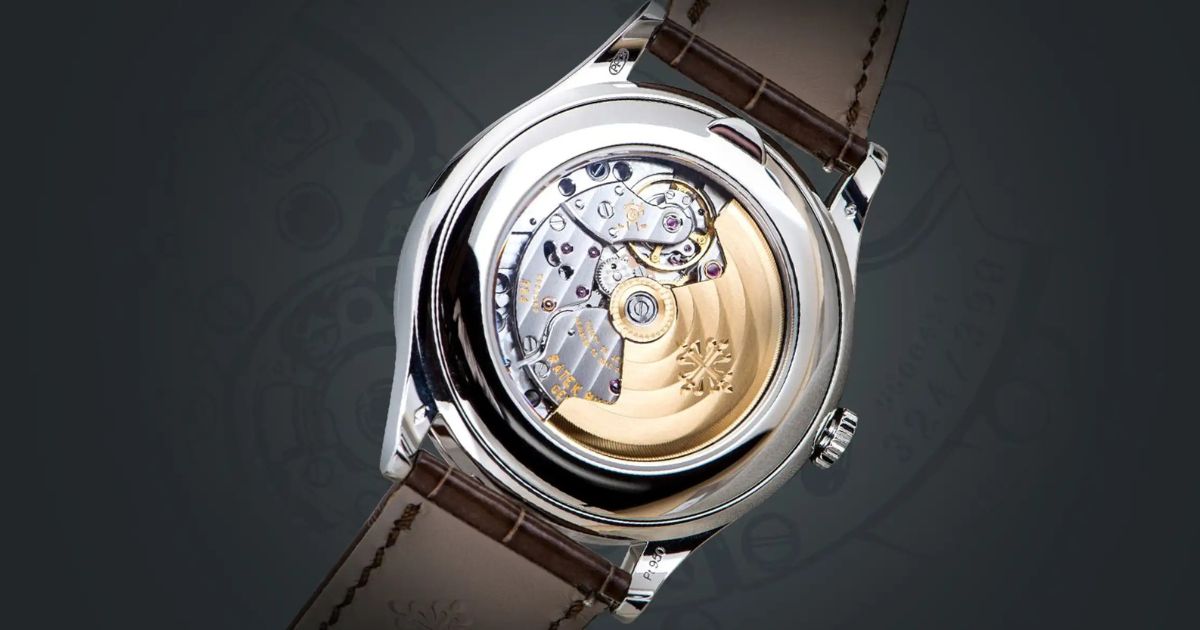
- The Rotor: This is the magic piece that sets automatics apart. It’s a semi-circular weight, often visible through the case back, that swings 360 degrees with the movement of your wrist. Connected to the winding mechanism, its motion winds the mainspring.
In short: Your movement spins the rotor, which winds the mainspring, which releases energy through gears and regulators to move the hands. It’s a miniature kinetic energy powerhouse on your wrist.
A Quick Note on Manual vs. Automatic:
A manual wind watch shares all the mechanics of an automatic but lacks the rotor. You must wind it by hand daily via the crown to tension the mainspring. An automatic essentially does this for you, but most can also be manually wound if they’ve been off the wrist for a while.
The Ingenious Engineering – How It Actually Works
The true brilliance lies in the winding mechanism. As you go about your day—gesturing, walking, typing—the rotor pivots freely. Each swing, through a series of reverser gears and a reduction gear, gently tightens the mainspring. A clever mechanism called a slipping clutch prevents overwinding; once the mainspring is fully tensioned, the rotor simply continues to move without further winding.
This stored energy is typically held in a power reserve. A fully wound modern automatic watch can run for 38 to 48 hours or even longer when off the wrist. This is why watch enthusiasts often use watch winders for pieces in a rotation, though it’s not strictly necessary.
Why They Matter – The Allure Beyond Timekeeping
An automatic watch is more than an instrument; it’s a statement. Here’s why they hold such a revered place in the world of luxury:
1. A Triumph of Micro-Engineering:
In an age of silicon chips, the automatic movement is a testament to tactile craftsmanship. It comprises hundreds of tiny parts, each meticulously finished, polished, and assembled by human hands (in the realm of haute horology). Owning one is owning a piece of intricate, functional art.
2. A Connection to History and Legacy:
The self-winding mechanism has roots in the 18th century, perfected in the 20th. Wearing an automatic connects you to centuries of innovation. Many brands’ calibers (movements) are evolved from designs decades old, carrying forward a lineage of technical mastery.
3. The Personal, Perpetual Motion:
There’s a unique, intimate relationship between an automatic watch and its owner. Its life is directly tied to yours. When it stops, it’s because you stopped moving. Winding it or putting it on to bring it back to life is a small, daily ritual that grounds you in the physical world.
4. Beauty in Transparency:
The exhibition case back is a common and beloved feature. It offers a window into the soul of the watch—revealing the decorated rotor, the perlage on the plates, the blued screws, and the hypnotic oscillation of the balance wheel. It’s a private show of mechanical ballet.
5. Sustainability and Longevity:
A well-maintained automatic watch can last for generations. It doesn’t rely on obsolete batteries or upgrade cycles. It can be serviced, repaired, and passed down, becoming an heirloom that carries personal history. This “buy once, cherish forever” philosophy stands in stark contrast to our disposable culture.
6. The Distinctive “Sweep”:
Due to the high frequency of the balance wheel, the second hand moves in a near-fluid sweep, distinct from the jerky tick of a quartz movement or the static digital display. It’s a visually satisfying marker of true mechanical provenance.
Living with an Automatic – What to Know
- Accuracy: Don’t expect atomic-clock precision. A well-tuned automatic might gain or lose a few seconds per day. This variance, often called its “personality,” is accepted as part of its mechanical charm.
- Service Intervals: Like a fine car, it requires periodic care. A full service by a qualified watchmaker every 5-7 years is recommended to clean, oil, and regulate the movement, ensuring longevity.
- Magnetism: Modern watches often have anti-magnetic properties, but strong magnetic fields from speakers, laptops, or medical equipment can affect accuracy. If your watch suddenly runs fast, it may have become magnetized—an easy fix for a watchmaker.
- Power Reserve: Be mindful of it. If you have a collection and don’t wear a piece for a couple of days, it will stop. You’ll need to reset the time, date, and wind it when you next wear it—a small but satisfying interaction.
Conclusion: More Than a Watch, A Companion
Choosing an automatic watch is a choice for connection over convenience, for artistry over automation, and for legacy over obsolescence. It is a declaration that you value the journey of craftsmanship, the poetry of mechanics, and the quiet, constant reminder of your own motion through life.
In a world that moves at the speed of a swipe, an automatic watch asks you to appreciate the slow, beautiful sweep of a second hand—powered not by a distant cell tower, but by the very rhythm of your existence. That is the essence of why it matters.