



Our Magazine
Speedmaster: How a Watch Went to the Moon

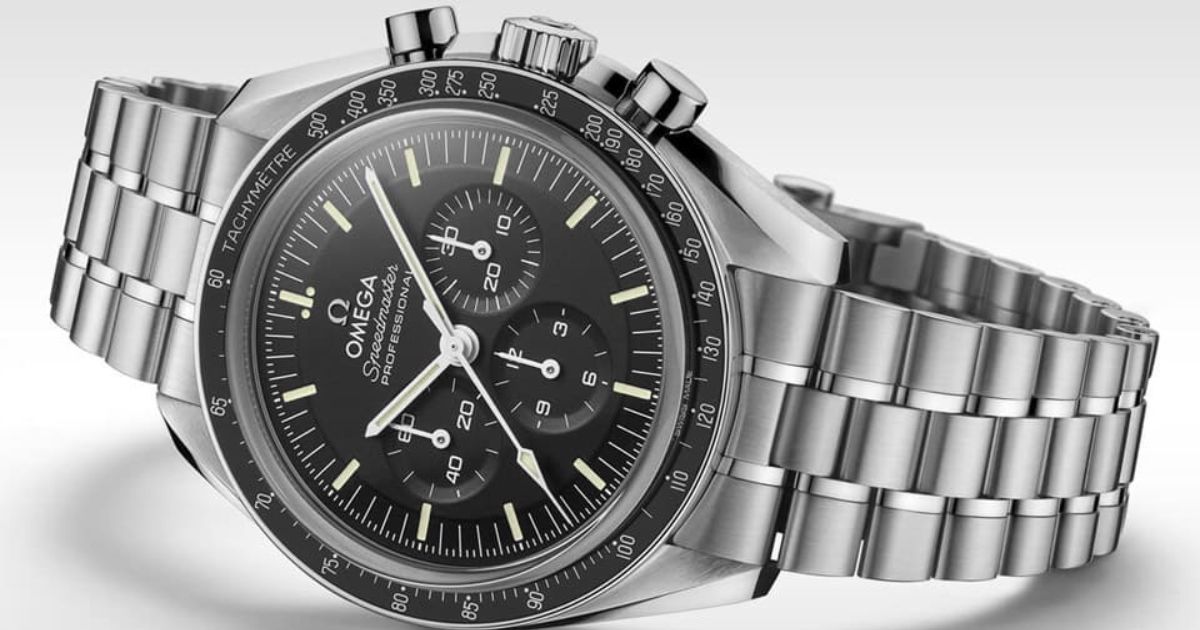
If you were to ask a child to draw a watch that went to the moon, they’d likely sketch something with rocket ships, blinking lights, and futuristic dials. The profound irony, and the sheer magic, of the Omega Speedmaster is that it looked nothing like that. In the 1960s, it was a handsome, legible, robust chronograph—a tool watch designed for scientists, engineers, and race car drivers. Yet, it became the only timepiece to be certified for, and survive, the vacuum of space and the dust of the lunar surface. This is the story of how a wristwatch transcended its earthly origins to become the “Moonwatch,” an icon of human achievement.
Earthly Origins – The Tool Watch Genesis
Long before it gazed upon the stars, the Speedmaster was born with its feet firmly on the ground. Introduced by Omega in 1957 as part of their “Professional” trilogy (alongside the Seamaster and Railmaster), its original purpose was terrestrial. Its defining features, which would later prove cosmic, were all born from pragmatic design:
- The Broad Arrow Hands and Bold Indexes: Designed for maximum legibility at a glance—crucial for a racing driver timing laps.
- The Black, Step-Tiled Dial: Reduced glare and created visual depth, enhancing contrast.
- The Tachymeter Bezel: A scale engraved on the bezel to calculate speed based on time over a fixed distance, the epitome of its motorsport intent.
- The Robust Manual-Wind Calibre 321: A legendary, column-wheel chronograph movement known for its smooth operation and reliability.
It was, in essence, a perfect instrument for measuring elapsed time. This inherent utility is what first caught the eye of a different kind of professional.
The “Right Stuff” – NASA’S Brutal Trials
In the early 1960s, NASA began operational planning for the Apollo missions. Astronauts, all test pilots by trade, needed a reliable, personal chronograph. With no time to develop one from scratch, NASA quietly procured chronographs from several leading brands. What followed was a “Qualification Testing Program” of almost sadistic intensity, designed to break machines.
The watches were subjected to extremes no earthly activity could replicate:
- Thermal Tests: Frozen for hours at -18°C, then baked at 93°C in rapid succession.
- High-Pressure and Vacuum Tests: Simulating the brutal lack of atmosphere in space.
- Humidity, Corrosion, and Acceleration Tests: Spun in a centrifuge to simulate high-G forces.
- Shock, Vibration, and Acoustic Noise Tests: Mimicking the violent shudder of rocket launch and re-entry.
- Decompression Tests: Rapid pressure changes that could cause crystals to pop off.
One by one, the competitors failed. Crystals detached, hands froze, dials faded. Only one watch emerged still functioning perfectly: the Omega Speedmaster Professional (reference 105.012, powered by Calibre 321). In March 1965, it was officially “Flight Qualified for All Manned Space Missions.” The Speedmaster was no longer just a tool watch; it was a piece of flight hardware.
From Orbit to Ocean of Storms – Defining Moments
The Speedmaster’s journey to legend was written in specific, pulse-quickening moments:
- Gemini 3 (1965): The first NASA mission to carry the Speedmaster, though unofficially. It was Gus Grissom’s personal watch.
- Gemini 4 (1965): Ed White performed America’s first spacewalk (EVA) with a Speedmaster strapped over the sleeve of his spacesuit. The iconic image cemented its place in history.
- Apollo 11 (1969): The culmination. On July 21st, at 02:56 UTC, Neil Armstrong descended the lunar module ladder. His Speedmaster (reference 105.012) was left in the LM as a backup timer after the cabin’s electronic timer failed. Moments later, Buzz Aldrin stepped onto the Sea of Tranquility with his Speedmaster (reference 105.012) on his wrist, making it the first watch worn on the moon. Aldrin called it “the lunar dust-proof watch.”
- Apollo 13 (1970): The ultimate test. After an explosion crippled the spacecraft, the crew used their hand-wound Speedmasters to time the critical 14-second engine burn for re-entry trajectory correction. This split-second precision, performed in a dark, freezing, powerless capsule, was vital for their safe return. Omega later received NASA’s “Silver Snoopy Award” for its role in saving the mission.
Anatomy of a Legend – Design Language Frozen in Time
What makes the Moonwatch so endlessly compelling to collectors is its “evolution in stasis.” While the movement has been updated (from Calibre 321 to 861 to today’s Co-Axial Master Chronometer Calibre 3861), the core aesthetic DNA remains protectively preserved.
Key vintage cues still present in the modern “Moonwatch” include:
- The Asymmetric Case: The larger left-side profile protects the crown and pushers from impacts.
- The Hesalite Crystal: Not sapphire. NASA chose this acrylic glass because it doesn’t shatter; it cracks or chips, protecting the dial integrity in a vacuum. Its warm glow and the charming “omega” logo distortion are beloved traits.
- The Dot-Over-90 Bezel: A subtle nod to pre-1970s models.
- The Step Dial: Creating that signature play of light and shadow.
- The Manual-Wind Movement: A direct, tactile link to the past. Astronauts had to wind it daily—a ritual connecting them to their machine.
The Moonwatch Today – More than a Chronograph
Today, the Speedmaster Moonwatch is in a unique category. It is not merely a luxury watch; it is a “history machine.” On the wrist, it carries the weight of narrative. Every time you wind it, you perform the same action Buzz Aldrin did in the Lunar Module. Every time you use the chronograph to time a mundane event, you’re engaging with the same mechanism that timed engine burns for survival.
For the learner and enthusiast, the Speedmaster teaches crucial lessons in horology:
- Tool-Watch Integrity: How form follows function to create timeless design.
- Mechanical Resilience: The triumph of analogue precision in a digital world.
- Provenance and Story: How a watch’s true value is woven from its historical journey.
- Evolution vs. Revolution: How to update a icon respectfully, maintaining its soul while improving its heart (the movement).
The Speedmaster did not go to the moon because it was the most expensive or complicated watch of its day. It went because it was the toughest, most legible, and most reliable. Its journey from dashboard to spacesuit is a testament to the idea that the right tool, designed with purpose and built with integrity, can find itself at the center of humanity’s greatest adventures.
Wearing a Moonwatch is not about telling the time on Earth. It’s about carrying a piece of human ambition on your wrist—a tiny, ticking reminder that we have walked on another world, and that a humble chronograph was right there with us, every second of the way.