


Our Magazine
Battle of the Icons: Cartier Tank vs. Jaeger-LeCoultre Reverso

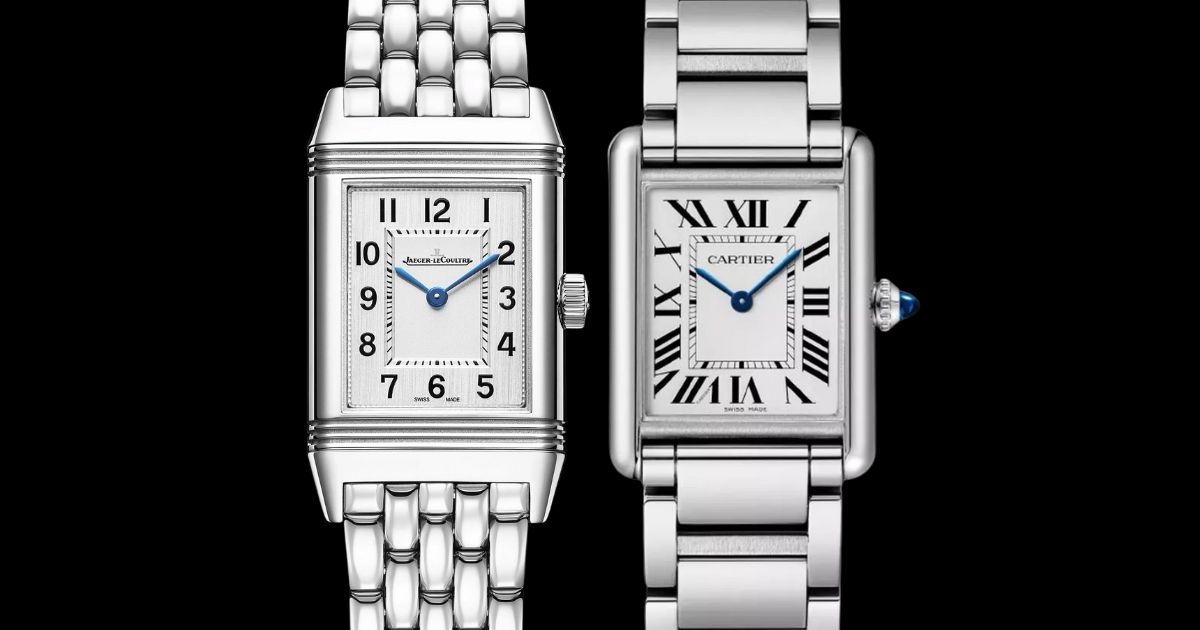
In the rarefied world of horology, where legends are measured in decades and icons in centuries, two rectangular timepieces stand as titans. They are not just watches; they are portable monuments to design, history, and an unwavering sense of self. On one wrist, the Cartier Tank, an embodiment of timeless elegance born from the trenches of war. On the other, the Jaeger-LeCoultre Reverso, a masterpiece of mechanical ingenuity forged on the polo fields. This is a battle not of superiority, but of philosophy. Which iconic rectangle speaks to you?
Genesis – War and Sport
Every great icon has an origin story that defines its soul.
The Cartier Tank arrived in 1917, a product of Louis Cartier’s visionary mind. Inspired by the aerial, top-down view of the Renault FT-17 tanks on the Western Front of WWI, Cartier distilled raw military machinery into pure, wearable elegance. The parallel brancards (the vertical sides), the clean dial resembling a tank’s treads, and the minimalist Roman numerals—it was a radical act of alchemy. It transformed the hard angles of war into the ultimate symbol of peace and sophistication. Its first patron? The legendary American General John J. Pershing. From its inception, the Tank was less about telling time with precision and more about declaring an attitude.
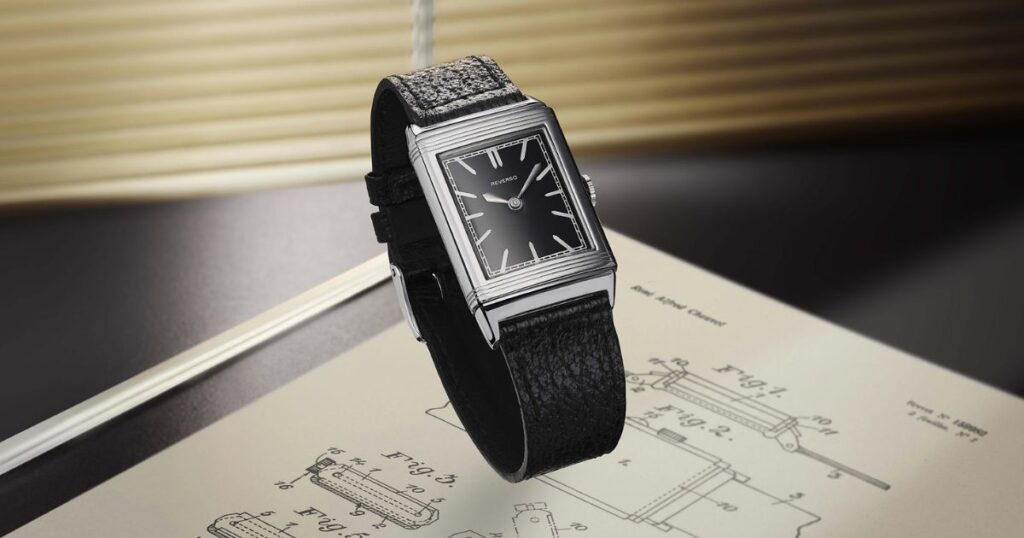
The Jaeger-LeCoultre Reverso emerged in 1931 from a specific, genteel problem. British Army officers stationed in India challenged watchmakers to create a timepiece that could survive the rigors of a polo match. The Swiss businessman César de Trey, working with Jaeger-LeCoultre, presented the ingenious solution: a sleek Art Deco case that could slide along its chassis and flip completely, protecting the fragile crystal and dial. The Reverso was born not from abstraction, but from pure, dynamic functionality. Its soul is one of duality—public face and private reverse, a watch of two personalities.
Design Language – The Art of the Rectangle
While both are rectangular, their execution reveals utterly different schools of thought.
The Cartier Tank is a study in pure, almost Platonic form. It is first and foremost a piece of jewellery that tells time. Its design is governed by strict, harmonious proportions. The brancards are never mere lugs; they are integrated, flowing extensions of the case, creating a seamless silhouette. The dial is a clean canvas: blued steel sword-shaped hands (the famous aiguilles), chemin-de-fer minute track, and those unmistakable Roman numerals. The sapphire cabochon set into the crown is the final jewel-like flourish. Whether in the classic Tank Louis Cartier (with its softened, curved brancards), the more geometric Tank Américaine, or the modernist Tank Française, the design language is always one of elegant, unwavering poise. It’s worn over the cuff, as a statement.
The Jaeger-LeCoultre Reverso is an exercise in geometric dynamism. Its case is longer, more pronounced, with strong, central gadroons (the vertical grooves). It feels architectural, engineered. The magic, of course, is in the flip. The swiveling case is a piece of micro-engineering that delivers a deeply satisfying, precise click. This functionality birthed its aesthetic duality. The front dial is often a model of Art Deco restraint, but the solid metal back became a canvas for personalization—engravings, enamel miniatures, or grand complications. Modern Reversos have embraced this duality with models like the Duoface (two dials showing two time zones) or the Triptyque (three displays). It is a watch you interact with.
Movement & Horology – The Heart of the Matter
Here lies perhaps the most profound distinction for the watch enthusiast.
Cartier, for much of the Tank’s history, has been a maison renowned for design and style. Historically, Tanks were powered by reliable, often sourced, mechanical movements or quartz. The watch’s value was in its form, its name, and its transcendent style. However, in recent decades, Cartier has made staggering investments in haute horlogerie through its manufacture in La Chaux-de-Fonds. Today, you can find Tanks with exquisite in-house movements, including ultra-thin calibers. Yet, even with these mechanical wonders, the soul of the Tank remains aesthetic. It is a watch chosen first for how it looks and what it represents.
Jaeger-LeCoultre, nicknamed “the watchmaker’s watchmaker,” is fundamentally a movement manufacturer first. The Reverso, from the very beginning, was a showcase for JLC’s technical prowess. Housing a reliable, well-finished movement within a long, thin, flipping case was a challenge they mastered. Over the decades, the Reverso has been a platform for some of JLC’s most astonishing complications: tourbillons, minute repeaters, perpetual calendars, and the groundbreaking Gyrotourbillon. To choose a Reverso is to inherently engage with mechanical artistry. Its flipping case is an invitation to explore what lies beneath—both literally and technically.
The Wearer’s Reflection: Which Icon Are You?
Choosing between these two is an exercise in self-definition.
You might be a Cartier Tank person if:
- You believe style is timeless and precedence is everything.
- Your wardrobe has a strong sense of architecture—clean lines, tailored pieces, a mix of androgynous and elegant.
- You appreciate art, design, and cultural history. You value the iconic moment when a watch transcended its function to become a symbol.
- You see your watch as the final, perfect accessory—a piece that completes an outfit with quiet, unquestionable authority.
You might be a Jaeger-LeCoultre Reverso person if:
- You are fascinated by mechanics, ingenuity, and problem-solving.
- You appreciate duality and complexity—in objects and perhaps in yourself.
- You enjoy interaction with your possessions; the flip is a ritual that never gets old.
- You are drawn to understatement with hidden depth. The true marvel of the Reverso isn’t always visible to the outside world.
Verdict: A Battle with Two Winners
In the end, the Battle of the Icons concludes not with a knockout, but with a respectful nod across the room.
The Cartier Tank is iconic art. It is the watch of Andy Warhol (who famously said he didn’t wear it to tell time), Princess Diana, and countless luminaries. It is a cultural touchstone, a design so perfect it has remained essentially unchanged for over a century. It teaches us that in watchmaking, courage of aesthetic vision can create a legacy just as enduring as any technical feat.
The Jaeger-LeCoultre Reverso is iconic engineering. It is the watch of the connoisseur who finds equal joy in the sleek lines of the case and the intricate symphony of the movement within. It represents the brilliant application of mechanics to serve a lifestyle, which in turn created an entirely new genre of watch.
So, which to choose? Perhaps the answer lies in your own reflection. Do you seek the timeless, poised statement that whispers of history and style? Let the Tank grace your wrist. Or do you crave the interactive, engineered marvel, a watch of two faces that rewards curiosity and technical appreciation? Slide the Reverso case and flip it over. Your choice, in this most glorious of battles, is between two perfect kinds of perfection.