


Our Magazine
Born from the Deep: The Legendary Story of the Fifty Fathoms

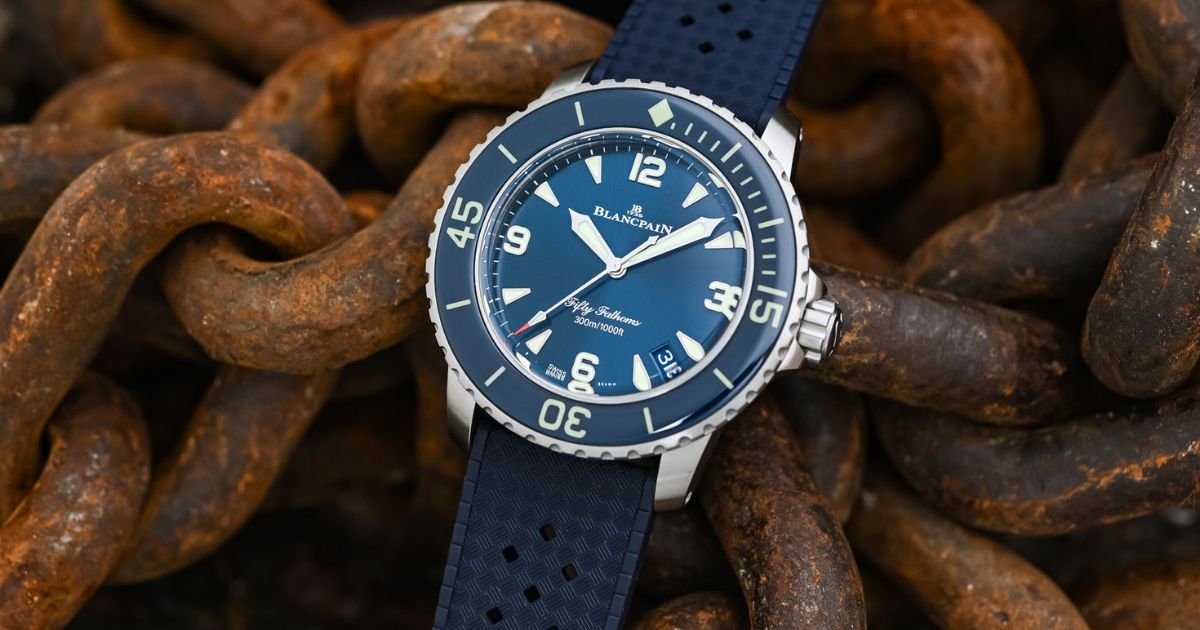
In the rarefied world of luxury watchmaking, certain names resonate not just as timepieces, but as legends forged in the crucible of necessity. They are born not from mere commercial ambition, but from a tangible, often perilous, human challenge. Among these icons, one stands as the undisputed progenitor of the modern dive watch: the Blancpain Fifty Fathoms. Its story is a captivating tale of innovation, military partnership, and cinematic elegance, woven into the very fabric of underwater exploration.
The Spark: A Diver’s Need, an Officer’s Vision
Our narrative begins in the early 1950s. Two French naval officers, Captain Robert “Bob” Maloubier and Lieutenant Claude Riffaud, were tasked with founding France’s first elite combat diving unit, the Nageurs de Combat. In an era of rudimentary equipment, they faced a critical problem: no wristwatch could withstand the rigors of their missions—constant immersion, shocks, magnetic fields from mines, and the critical need for clear, legible timing in the murky depths.
Frustrated by rejections from established watch brands, they found an unlikely ally in Jean-Jacques Fiechter, the CEO of Blancpain. A passionate diver himself, Fiechter intimately understood their requirements. Here, the first pillar of the Fifty Fathoms was laid: function born from genuine user experience. This wasn’t a marketer’s idea of a dive watch; it was a tool designed by divers, for divers.
The Blueprint: Defining the Modern Dive Watch
What Fiechter and his team created between 1952-1953 was nothing short of a blueprint. The “fifty fathoms” name itself referred to the 91.45-meter depth rating (a fathom being six feet), which was considered the operational limit for the nascent aqualung. To achieve this, Blancpain established specifications that would become sacred tenets of dive watch design:
- Automatic Winding: Manual winding would require unlocking the crown, compromising water resistance. The automatic caliber (initially based on a robust Fiechter-designed movement) ensured the watch stayed wound through the diver’s arm movements.
- Unidirectional Rotating Bezel: Perhaps its most iconic feature. This allowed divers to securely mark their immersion time to prevent dangerous miscalculations of remaining air. The locking mechanism and the fact it could only turn counter-clockwise (so a accidental bump could only shorten, not lengthen, the indicated time) were revolutionary safety features.
- High Legibility: Large, luminous indexes and distinct hands (often with a cathedral-style hour hand) against a dark black dial ensured instant reading in low-light conditions.
- Water Resistance & Security: A double O-ring sealing system on the crown and a robust case back gasket created an imperious seal against water intrusion.
The Fifty Fathoms was born. It was a complete, integrated system for underwater timing.
The Military Pedigree: Adopted by the World’s Elites
Word of this exceptional tool spread swiftly through military channels. France’s Nageurs de Combat were the first adopters, but the tentacles of the Cold War quickly drew in other forces. The most famous partnership was with the United States Navy’s Explosive Ordnance Disposal (EOD) and Underwater Demolition Teams (UDTs), the precursors to the Navy SEALs. They sourced their Fifty Fathoms watches through the American company Tornek, which added a radium-lit, anti-magnetic Rayville case (Rayville being the phonetic reversal of Villeret, Blancpain’s home). The German Bundesmarine also equipped its divers with the watch.
This military adoption provided the ultimate field testing. The Fifty Fathoms wasn’t just worn; it was relied upon in life-or-death situations, cementing its reputation for indestructible reliability.
The Civilian Icon: From Depths to the Silver Screen
While serving the world’s elite divers, the Fifty Fathoms also made a seamless transition to civilian life, becoming a symbol of adventure. Its most glamorous ambassador was none other than Jacques-Yves Cousteau. In his iconic 1956 Oscar-winning documentary The Silent World, Cousteau’s crewmembers are visibly wearing Fifty Fathoms watches as they pioneer scuba exploration aboard the Calypso. The watch was there, on the wrist of history, as humanity learned to breathe underwater.
Furthermore, its distinctive design—the boxy case, the black dial, the serrated bezel—became a style statement. It represented a connection to a world of adventure, technology, and courage.
Evolution and the Modern Legacy
The journey of the Fifty Fathoms didn’t stall in the 20th century. After a period of dormancy, Blancpain brilliantly revived the legend in the 2000s, honoring its DNA while embracing 21st-century haute horlogerie. Today’s collection offers variations: the classic Fifty Fathoms Automatique faithfully interprets the original’s proportions; the Bathyscaphe line nods to a more streamlined, 1960s-style model; and the Fifty Fathoms Tech Gombessa pushes boundaries with a staggering 3-hour graduation on its bezel, designed for modern saturation diving.
Yet, across all models, the core principles remain untouched. The sapphire unidirectional bezel (a modern innovation with stunning visual depth), the legible dial, the robust automatic movements (now in-house and meticulously finished), and that undeniable aura of tool-watch authenticity.
A Legend Forged in Water
The story of the Blancpain Fifty Fathoms is more than a chronicle of a watch. It is a lesson in purpose-driven design. It teaches us that the most enduring luxury is not mere ornamentation, but competence elevated to an art form. It reminds us that true icons are often born from a specific, demanding need—in this case, the silent, pressurized world beneath the waves.
For the watch enthusiast and learner, the Fifty Fathoms represents a foundational chapter in horological history. To understand it is to understand the genesis of an entire category. It is a timepiece that whispers of clandestine military operations, echoes with the pioneering spirit of Cousteau, and continues to serve as a reliable companion for those who venture into the deep. It wasn’t created to sit in a vault; it was Born from the Deep to explore it. And on the wrist, it carries not just time, but a legendary story of human ingenuity and adventure.