



Our Magazine
Cartier Tank vs. Jaeger-LeCoultre Reverso: The Rectangle Showdown

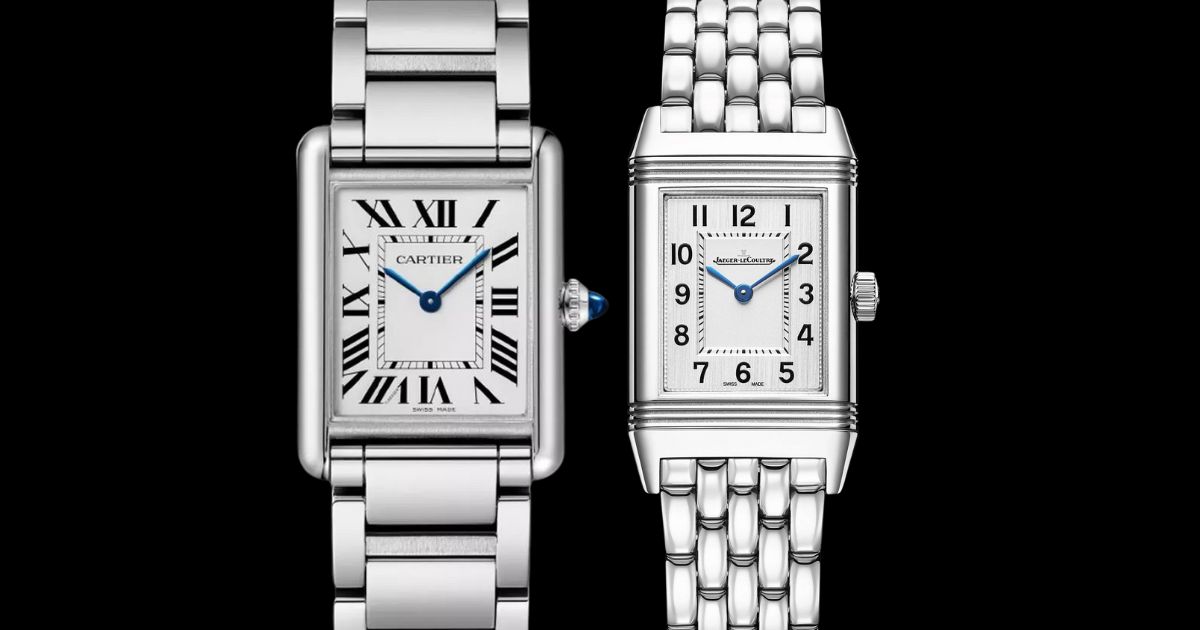
In the rarefied world of haute horlogerie, where round cases often reign supreme, two rectangular icons stand as eternal testaments to design genius and narrative power. The Cartier Tank and the Jaeger-LeCoultre Reverso are more than just watches; they are cultural touchstones, embodiments of distinct philosophies worn on the wrist. Choosing between them is not merely a matter of taste, but an alignment of identity. In this rectangle showdown, we delve into the soul of each legend.
The Birth of an Icon – History & Ethos
Cartier Tank: The Modernist Monument
Born in 1917 and credited to Louis Cartier, the Tank’s origin story is one of the most celebrated in watch lore. Inspired by the aerial view of Renault FT-17 tanks on the Western Front, it translated the brute machinery of war into an object of pure, serene elegance. Its design was radical: clean brancards (the vertical bars), a minimalist dial with Roman numerals, and that signature chemin-de-fer (railroad) minute track. It wasn’t just a watch; it was a statement of modernism. From its earliest adoption by visionaries like Rudolph Valentino, the Tank became the ultimate symbol of effortless, avant-garde chic. It is art from the outside in, a masterpiece of design that houses respectable, often quartz or simple mechanical, watchmaking. Its ethos is style as a first principle.
Jaeger-LeCoultre Reverso: The Ingenious Survivor
The Reverso’s 1931 genesis is a tale of ingenious problem-solving. British army officers stationed in India sought a watch robust enough to survive polo matches. Jaeger-LeCoultre’s answer was revolutionary: a sleek Art Deco rectangular case that could swivel completely on its chassis, protecting the crystal and dial. The reversible case was a mechanical marvel, a perfect blend of form and function. While the polo story is central, the hidden caseback soon became a canvas for personalization—engravings, enamel art, even complications. The Reverso’s soul is one of hidden depth and technical resilience. It is engineering from the inside out, a watchmaker’s watch that celebrates mechanical artistry. Its ethos is versatility through ingenuity.
Anatomy of a Legend – Design & Wearing Experience
The Cartier Tank: Sculptural Purity
- Silhouette: The Tank is geometry perfected. Whether in the classic Tank Louis Cartier (with softened, curved brancards), the more assertive Tank Américaine (tonneau-shaped), or the minimalist Tank Française (with integrated bracelet), its profile is flat, elegant, and graphic. It sits close to the wrist like a piece of jewelry.
- The Dial: A study in legible perfection. Blued steel hands (poire or bâton), black printed Roman numerals, and the secret signature “Cartier” at the VII or X position. It is deliberately uncluttered, a dial designed decades ago that remains utterly contemporary.
- On the Wrist: The Tank is unapologetically elegant. It is lightweight, discreet, and meshes seamlessly with attire from a t-shirt to a tuxedo. It is often a “second watch” for collectors, but for many, it is the only watch needed. Its wear is about an attitude—a quiet confidence in timeless style.
The Jaeger-LeCoultre Reverso: Dynamic Duality
- Silhouette: The Reverso is defined by its central groove and sliding rails. It has a more substantial, architectural presence. The case is thicker to accommodate the reversing mechanism and, in many models, a second movement on the reverse side.
- The Dial: Pure Art Deco, with bold, applied hour markers and dagger-shaped hands. It feels more technical, more “watch-like” than the Tank’s painterly canvas. The real magic, however, lies in the duality. Flip it, and you may find: a second timezone (Duoface), a stunning engraved caseback, or a completely different dial style (Night & Day).
- On the Wrist: Wearing a Reverso is an interactive experience. The act of flipping it is deeply satisfying, a private ritual. It feels more sporty and robust than the Tank, yet just as dressy. It is a watch that invites engagement and tells two stories—one public, one deeply personal.
The Heart of the Matter – Movement & Horology
This is where their philosophical divide becomes most apparent.
Cartier Tank: Historically, Cartier sourced movements from great makers (including JLC itself!). Today, while many entry Tanks use quartz (a perfectly legitimate choice for this style-centric icon), the mechanical models are powered by solid, often Piaget-derived movements. The focus is on reliability and slimness to serve the design. The recent Tank Must with the SolarBeat photovoltaic movement shows Cartier innovating within its design-first paradigm. The horology is respectable, but it is in service to the form.
Jaeger-LeCoultre Reverso: This is where JLC, “the Watchmaker’s Watchmaker,” shines. Even a classic Reverso houses a finely finished, in-house manual-wind calibre. The line ascends into horological high art: the Duoface (two independent dials and movements in one case), the Quadriptyque (four dials with perpetual calendar and moon phases), and incredible métiers d’art on the reverso side. The Reverso platform is a testbed for mechanical creativity. The movement is not just an engine; it is the star of the show.
The Verdict: Who Are You Wearing?
Choosing between the Tank and the Reverso is an exercise in self-discovery.
Choose the Cartier Tank if:
You believe style is the ultimate complication. You are drawn to art, design, and fashion history. You want an object of timeless, minimalist beauty that transcends trends. You value understatement and wearability above mechanical spectacle. Your watch is the finishing touch to your personal aesthetic.
Choose the Jaeger-LeCoultre Reverso if:
You are fascinated by mechanics, history, and interactive design. You love the idea of a watch with a “secret”—a dual personality. You appreciate depth, both in narrative and horological content. You want a watch that feels sporty and dressy, classic yet engaging. Your watch is a companion for life’s adventures, with a story on both sides.
Conclusion: Not a Winner, But a Legacy
In this ultimate rectangle showdown, there is no loser. The Cartier Tank is the unassailable icon of style. It is the watch that taught the world that elegance is geometric. The Jaeger-LeCoultre Reverso is the unbeatable champion of ingenuity. It is the watch that proved functionality could birth an eternal legend.
One is a painting you wear; the other is a mechanical puzzle you carry. Both define, and are defined by, the wrists they have graced for nearly a century. The true victory lies in their continued dialogue—a constant reminder that in the world of high watchmaking, there will always be a place for the timeless elegance of the straight line.