


Our Magazine
Portugieser Decoded: A Guide to Its Models and Complications

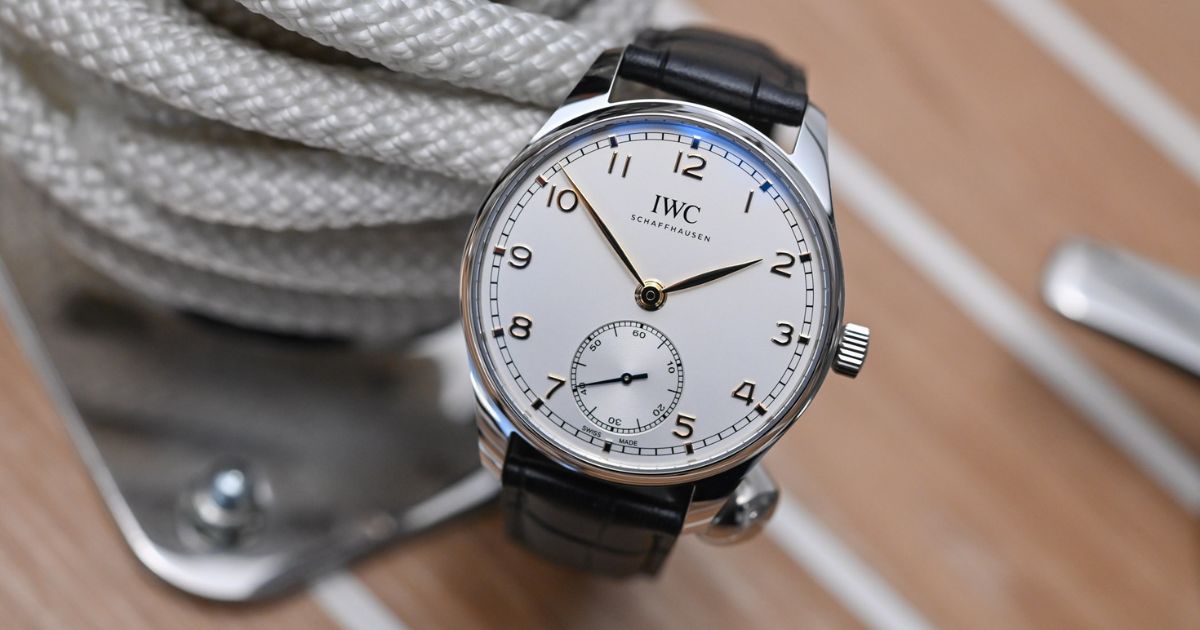
For the discerning watch enthusiast, few names evoke the spirit of maritime exploration and horological elegance quite like IWC Schaffhausen’s Portugieser. Born from a simple yet profound request for extreme precision, this collection has evolved into a cornerstone of modern watchmaking, seamlessly blending its nautical heritage with technical sophistication. For those navigating the rich waters of this iconic line, this guide decodes the Portugieser’s key families and their celebrated complications.
The Nautical Genesis: A Story of Precision
The story begins in the late 1930s, when two Portuguese merchants approached IWC with a unique demand: a wristwatch with the precision of a marine chronometer. IWC’s ingenious answer was to house a robust, high-precision pocket watch movement—the famous Calibre 74—into a suitably sized wristwatch case. The result was the original “Portugieser” (Reference 325), characterized by its clean, legible dial, Arabic numerals, and railway-track minute chapter. This DNA of clarity, size, and accuracy remains the collection’s beating heart.
Decoding the Core Models
While the Portugieser family has expanded, several core models form its foundation. Understanding these is key to appreciating the collection.
- Portugieser Automatic & Portugieser Chronograph: These are the modern pillars. The Automatic (often Ref. IW5007 and its successors) is the direct heir to the original’s spirit. It typically features a simple, breathtakingly balanced dial with date, small seconds at 6 o’clock, and showcases IWC’s legendary Pellaton winding system through a sapphire case back. The Chronograph (like the iconic Ref. 3714) presents the classic two-register layout (at 12 and 6 o’clock) with feuille hands, offering a perfect blend of sportiness and elegance. It’s the quintessential dress chronograph.
- Portugieser Perpetual Calendar: Perhaps the most revered of all IWC’s complications within this line. Masterminded by the legendary watchmaker Kurt Klaus in the 1980s, the Portugieser Perpetual Calendar integrates a complete calendar (date, day, month, moon phase) that mechanically accounts for different month lengths and leap years until 2100. Its signature display across four sub-dials is a masterpiece of information design, remaining stunningly legible and symmetrical.
- Portugieser Tourbillon: This is where haute horlogerie meets the Portugieser aesthetic. IWC often combines the tourbillon—a mesmerizing complication that counters the effects of gravity on accuracy—with other functions like a perpetual calendar or a mysterious retrograding date. The flying tourbillon at 6 o’clock, often framed by a dedicated sub-dial, becomes a captivating visual anchor.
- Portugieser Minute Repeater: Representing the pinnacle of acoustic artistry, the Minute Repeater is a rare and exquisite complication. On demand, it chimes the hours, quarters, and minutes on cathedral-style gongs. In the Portugieser, it’s frequently paired with a perpetual calendar, creating a grand complication of the highest order, all housed within the collection’s characteristically clean dial architecture.
- Portugieser Yacht Club: Introducing a more sporty, dynamic dimension. The Yacht Club models often feature enhanced water resistance, more robust cases, and sometimes a nautical-inspired aesthetic like a countdown timer or a regatta fly-back chronograph. They offer the Portugieser elegance in a context ready for active pursuits.
- Portugieser Hand-Wound & Portugieser Portofino: While Portofino is its own distinct line, the “Portugieser” designation is sometimes seen on special hand-wound models or limited editions that pay direct homage to the original’s size and simplicity, often with a power reserve indicator on the dial.
A Deep Dive into Key Complications
Beyond the models, it’s the execution of complications that truly defines the Portugieser’s technical identity.
- The Perpetual Calendar Module: IWC’s design is celebrated for its user-friendliness and mechanical intelligence. All calendar displays are advanced synchronously via the crown, a feat of ingenious engineering that prioritizes long-term reliability.
- The Double Moon Phase: On many perpetual calendars, the moon phase display for the northern and southern hemispheres is astonishingly precise, deviating by just one day in 577.5 years.
- The Tourbillon with Pellaton Winding: IWC ingeniously adapted its shock-resistant Pellaton winding system to work efficiently with the high torque demand of a tourbillon cage, a testament to its innovative approach to traditional complications.
- The Fly-Back Chronograph: Featured in models like the Yacht Club Chronograph, this allows for instantaneous resetting and restarting of the timing function with a single push of a button—an invaluable tool for timing consecutive events.
Design Language: The Unifying Code
Across all complications, the Portugieser speaks a consistent design language that ensures instant recognition:
- The Case: Defined by its elegant, rounded shape and thin, polished bezel that emphasizes the dial.
- The Dial: Clean, legible, and often layered. Features include Arabic numerals (typically applied), feuille (leaf-shaped) or alpha hands, and the essential railway-track minute chapter.
- The Strap: Almost universally presented on high-quality leather straps (often alligator), reinforcing its elegant, timeless character.
Modern Evolution and In-House Mastery
In recent years, IWC has progressively equipped the Portugieser line with in-house manufactured movements, such as the 52000 and 82000 calibre families. These bring technical advancements like ceramic components in the Pellaton winding system for durability and extended power reserves, often visible through exhibition case backs. Modern materials like ceratanium (a ceramic-titanium compound) have also been introduced, offering lightness and scratch-resistance while maintaining the classic aesthetic.
Conclusion: More Than a Watch, A Philosophy
Decoding the Portugieser is about understanding a philosophy: one where legibility and elegance are paramount, where a complication should enhance the user’s experience rather than obscure it, and where a rich history of exploration is always present. From the pure simplicity of the Automatic to the mechanical symphony of a Grande Complication, each Portugieser model is a chapter in a story about human ingenuity and the relentless pursuit of precision under a classic, timeless form.
For the collector, the journey through the Portugieser line offers a satisfying path—from appreciating its foundational aesthetics to marveling at its most complex mechanical achievements, all while wearing a piece of horological history on your wrist. It remains a true navigational instrument, not just for the seas, but for the passage of time itself.