


Our Magazine
The Art of Fusion: What Makes Hublot, Hublot

In the rarefied world of haute horlogerie, where tradition often reigns supreme, one name has consistently defied convention by embracing a radical, almost rebellious, philosophy: Hublot. The brand’s identity isn’t simply about telling time; it’s a statement—a bold, visual manifesto built on a single, powerful principle: “The Art of Fusion.” This isn’t just a marketing slogan; it’s the very DNA that courses through every component, every design, and every innovation that leaves its manufacture in Nyon, Switzerland. But what does this fusion truly entail, and how did it propel Hublot from an audacious newcomer to a powerhouse of modern watchmaking?
The Genesis of a Disruptive Idea
To understand Hublot’s present, one must rewind to its pivotal past. In 1980, watch industry veteran Carlo Crocco unveiled the very first Hublot watch. Its name, meaning “porthole” in French, hinted at its design inspiration, but the true shock was its material composition: a gold case paired with a black rubber strap. In an era where precious metals were exclusively married to alligator leather or metal bracelets, this was heresy. The fusion of the luxurious (gold) with the utilitarian, sporty, and unconventional (rubber) was a stroke of genius. It was uncomfortable, unexpected, and ultimately, irresistible. This initial fusion of materials shattered the unspoken rules of luxury, proving that opulence could be redefined through contrast and comfort.
However, the philosophy truly evolved and found its relentless driving force with the arrival of Jean-Claude Biver in 2004. As CEO, Biver didn’t just manage a brand; he amplified its core idea into a holistic doctrine. Under his visionary leadership, “The Art of Fusion” expanded from a material experiment into a multi-faceted ideology encompassing materials science, mechanical innovation, and cultural cross-pollination.
The First Pillar: Fusion of Materials
This is Hublot’s most tangible and celebrated domain. The brand operates like a high-tech alchemy lab, constantly researching and developing unprecedented materials. Their mission is to create substances that are not only visually striking but also superior in performance.
- Magic Gold: In collaboration with the Swiss Federal Institute of Technology in Lausanne (EPFL), Hublot created the world’s first scratch-resistant 18k gold. By fusing 24k gold with boron carbide, they produced a patented gold that can withstand the rigors of daily life—a perfect fusion of traditional luxury value and futuristic resilience.
- Sapphire Crystal Cases: While sapphire is used for crystal on many watches, Hublot pushed boundaries by machining entire, complex watch cases from solid blocks of synthetic sapphire. The result is a stunning, fully transparent (or tinted) vessel that showcases the intricate mechanics within, fusing supreme hardness with breathtaking aesthetics.
- Ceramics and Colored Alloys: Hublot’s research into ceramics led to vibrant, fade-resistant colors like bright red or blue—a technical challenge few have mastered. Similarly, alloys like King Gold (a warmer, more durable 18k gold with platinum) and Texalium (a fusion of aluminum and carbon fiber) showcase their relentless pursuit of new textures and hues.
- Unconventional Pairings: True to its roots, Hublot continues to juxtapose materials in thrilling ways: ceramic with rubber inserts, carbon fiber with denim, sapphire with titanium. Each combination tells a story of contrast, creating a unique visual and tactile language.
The Second Pillars: Fusion of Mechanics
Hublot’s fusion isn’t skin-deep. It extends into the very heart of the timepiece—the movement. The brand skillfully bridges traditional haute horlogerie with cutting-edge, purpose-built engineering.
- The Unico Movement: Born in-house, the Unico chronograph movement is a work of modern industrial art. It’s designed to be robust, modular, and aesthetically impressive, with its column wheel prominently displayed on the dial side. It represents a fusion of a classic chronograph architecture with contemporary manufacturing and design principles.
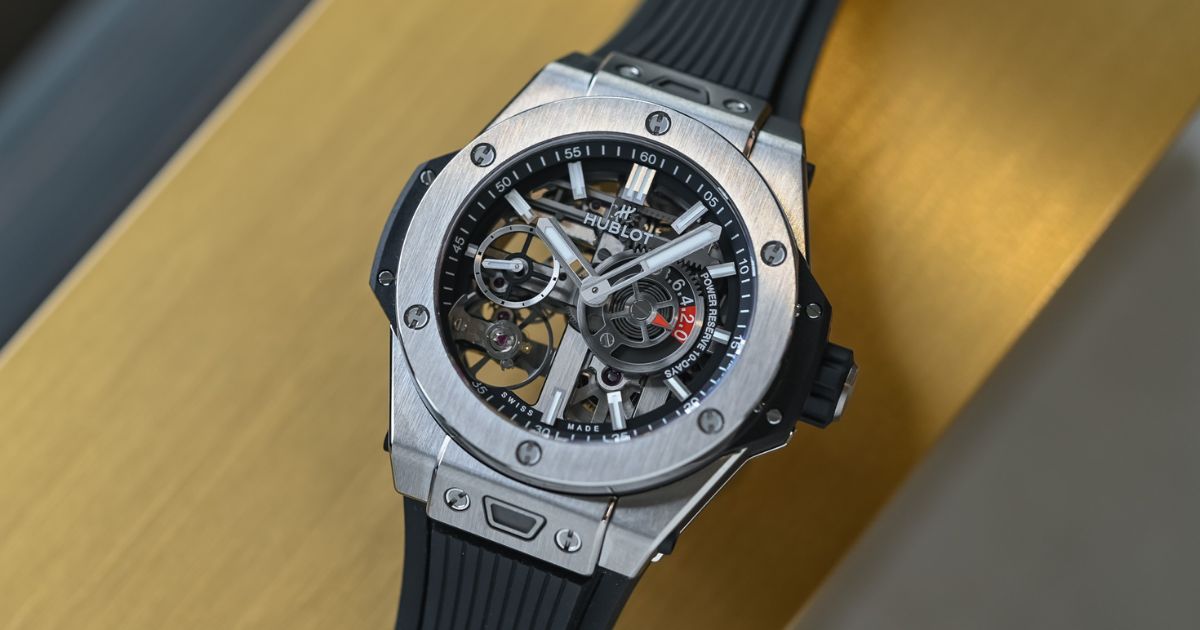
- The Meca-10: This manually-wound movement, with its compelling power reserve display reminiscent of a tension gauge, fuses the tactile, architectural appeal of a machine with precise timekeeping.
- Fusing Complications: Hublot isn’t afraid to inject its bold spirit into high complications. From the MP-05 “LaFerrari” with its staggering 50-day power reserve and vertical movement architecture, to tourbillons suspended within sapphire cages, their grand complications are never traditional rehashes. They are futuristic interpretations, fusing extreme mechanics with extreme design.
The Third Pillars: Fusion of Cultures
Perhaps the most accessible and vibrant aspect of Hublot’s philosophy is its cultural fusion. Hublot acts as a cultural curator, forming deep partnerships with icons from diverse worlds, creating limited editions that are more than just logo swaps.
- Sports: Long-standing partnerships with FIFA (for the World Cup) and Premier League clubs like Chelsea and Juventus see fusion in materials like carbon fiber and designs inspired by team colors and stadium architecture.
- Art & Design: Collaborations with artists like Takashi Murakami (fusing his smiling flower motif with a rotating tourbillon) or sculptors like Richard Orlinski (incorporating his faceted “Cut” design) transform watches into wearable art.
- Music & Fashion: From Berluti’s aged leather dials to partnerships with pioneers like DJ Snake or Sang Bleu tattoo studio, these collaborations fuse horology with street culture, sound, and texture.
- Industry & Exploration: Teaming with Formula 1 teams, Alinghi sailing, or even creating a watch for NASA engineers, Hublot fuses its engineering mindset with that of extreme performance professionals.
The Hublot Design Language: A Cohesive Result
All this fusion coalesces into an instantly recognizable design language. The “porthole” case, with its distinctive H-shaped screws, acts as a robust frame for these experiments. The multi-layered, sandwich-style dials create depth and legibility. The integrated strap system—allowing for a quick, tool-less interchange of straps from rubber to leather to titanium—is the ultimate expression of fusion, letting the wearer personalize the watch’s character in seconds.
Conclusion: More Than a Watch, a Mindset
So, what makes Hublot, Hublot? It is the unwavering commitment to its founding paradox. It is the belief that the collision of opposites—old and new, precious and pragmatic, classic and avant-garde, mechanical and cultural—creates not conflict, but a new, dynamic form of beauty and relevance. Hublot watches are not meant to be discreet heirlooms of a bygone era; they are bold proclamations for the present, designed for individuals who see the world not in binaries, but in fascinating, interconnected layers.
For the watch enthusiast and learner, studying Hublot is a masterclass in how a clear, disruptive philosophy, when executed with conviction and technical prowess, can carve out an unassailable niche in a crowded field. The Art of Fusion is a reminder that in watchmaking, as in all creative pursuits, the most exciting frontiers are often found not in purity, but in the revolutionary space where different worlds meet.