


Our Magazine
The Ref. 1518: The Watch That Started the Steel Chrono Craze

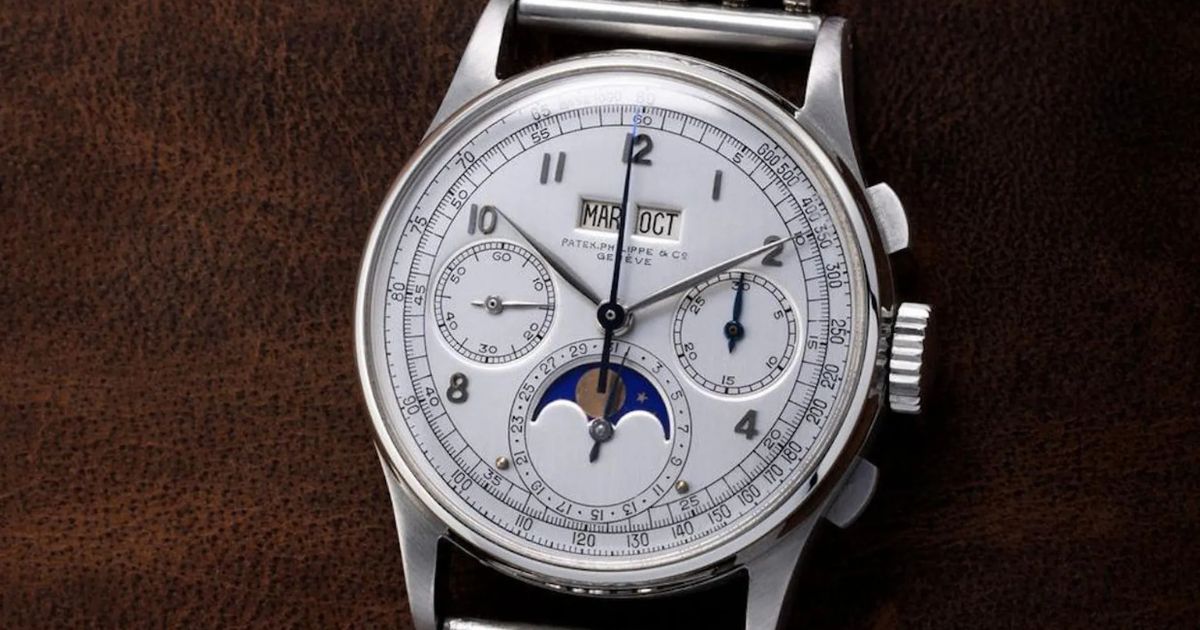
If you were to ask any serious watch enthusiast to name the most significant, collectible, and mythologised category in vintage watch collecting, the answer would be unanimous: the steel chronograph. These are the watches that command headlines at auction, inspire endless forum debates, and form the cornerstone of legendary collections. But this entire phenomenon—this “steel chrono craze”—traces its lineage back to a single, pivotal reference. It wasn’t a Rolex Daytona, nor an early Heuer. It was a Patek Philippe. The reference 1518.
Today, the very idea of a Patek Philippe chronograph is synonymous with the highest echelons of haute horlogerie. But in 1941, when the ref. 1518 was introduced, it was nothing short of revolutionary. To understand its impact, we must step back into its world.
The Pre-1518 Landscape: Complicated Watches Were Not Sporty
Before the 1518, wristwatch chronographs were largely considered practical, utilitarian tools. They were often housed in modest, sometimes even base-metal, cases. Perpetual calendars, on the other hand, resided in a different universe. They were the epitome of complication, typically found in precious yellow gold or platinum dress watches, tracking the moon, date, day, and month with mechanical poetry. These two functions—the stopwatch of the chronograph and the astronomical intelligence of the perpetual calendar—simply did not mix. They were disciplines apart.
Patek Philippe’s audacious genius with the 1518 was to fuse them. It was the world’s first serially produced perpetual calendar chronograph. This alone would cement its place in history. But Patek went further. They presented this mechanical marvel in a case that was both elegant and assertive, with stepped lugs, a clean bezel, and that iconic twin-button chronograph layout. It was a watch of profound complication dressed with a new kind of purposeful sophistication.
The Steel That Forged a Legend
Here is where the story turns from significant to legendary. The vast majority of reference 1518s—about 281 examples—were crafted in yellow gold. A handful were made in pink gold. But according to the most authoritative research, only four examples were ever cased in stainless steel.
In the 1940s, steel was not the coveted material it is today. It was industrial, it was practical, it was for tool watches and military equipment. For Patek Philippe to pour their most complicated movement of the era into a steel case was an almost paradoxical decision. It was like placing a grand symphony orchestra on a factory floor. This rarity was not a marketing ploy; it was likely a result of extremely limited demand for such a costly complication in a “humble” metal at the time.
These four steel examples became the sleeping giants of watch collecting. As the collecting world matured in the late 20th century, a new philosophy emerged. Collectors began to prize the ultimate expression of a watch’s design: its most tool-like, pure, and understated form. For a complicated Patek, what could be more pure, more focused on the mechanics and the form than the absence of precious metal? Steel was honest. Steel was tough. Steel was cool.
The revelation of the steel 1518’s existence and its subsequent appearance at auction in 2016 didn’t just break records; it rewired the collective mindset of high-end collecting. It conclusively proved that the ultimate prize was the rarest iteration of the most important reference. It created the template: Ultimate Importance + Ultimate Rarity = The Ultimate Collectible.
Anatomy of an icon: Why the 1518 Design Endures
Beyond its material mythology, the 1518 established a design language that Patek’s complicated watches would follow for decades.
- The Perfect Dial Architecture: The 1518 mastered the art of legibility within complexity. The two subsidiary dials at 3 and 9 o’clock (for the 30-minute chronograph recorder and continuous seconds) are balanced by the moonphase and combined day/month aperture at 12 o’clock. The date is tracked on a peripheral chapter ring with a elegant pointer hand. Every element has its place, creating a harmonious yet information-rich symphony. This layout became the blueprint for its legendary successor, the ref. 2499, and echoes even in modern references like the 5270.
- The “Observatoire” Chronograph Movement: Beating inside is the legendary Caliber 13”’ Q (the Q for Quantieme Perpetuel, French for perpetual calendar). This robust, column-wheel chronograph movement was based on a proven Victorin Piguet ébauche, which Patek Philippe finished and modified to its own sublime standards. It was the reliable, high-performance heart that made this groundbreaking serial production possible.
- The Case Presence: At 35mm, it sounds modest by today’s standards. But the 1518 wears with tremendous presence. The case, with its distinctively shaped lugs that flow from the mid-case, has a sculptural, architectural quality. It sits proudly on the wrist, a clear statement of intent.
The Ripple Effect: Creating the “Craze”
The 1518, particularly in steel, laid the psychological and market foundation for the steel chronograph craze in several key ways:
- It Established the Hierarchy: It proved that within a model line, the steel version could become the most desirable and valuable, flipping traditional notions of luxury on their head.
- It Married Complication with Tool-Watch Spirit: It showed that the most intricate mechanics could be housed in a case material associated with resilience and activity, creating a irresistible juxtaposition of high art and robustness.
- It Created the “Unobtainable Grail” Narrative: The story of the four steel 1518s became a fable every collector knew. It made other rare steel chronographs—from Rolex’s ref. 6062 “Bao Dai” to early Audemars Piguet chronographs—not just old watches, but potential hidden treasures echoing the 1518’s narrative.
This legacy directly fuels the passion for watches like the Rolex Daytona “Paul Newman,” the early steel Patek Philippe ref. 130, and the ultra-rare split-seconds chronographs from other elite makers. They are all, in a sense, chasing the aura established by the 1518.
Conclusion: The Unshakeable Foundation
The Patek Philippe reference 1518 is more than just a watch. It is the genesis point. It was the first to combine supreme complication with a timeless design language, and through its vanishingly rare steel executions, it authored the defining rulebook for modern collecting desirability.
Every time a steel chronograph makes headlines, every time a collector speaks of a “holy grail,” and every time Patek Philippe unveils a new perpetual calendar chronograph, the ghost of the reference 1518 is there. It was the watch that dared to be both a masterpiece of complication and, in its purest form, a rugged steel companion. In doing so, it didn’t just tell the time; it started an entire craze that continues to captivate the watch world to this day. It is, quite simply, where the story of the modern collector’s chronograph begins.