



Our Magazine
The RM 011: Deconstructing an Iconic Flyback Chronograph

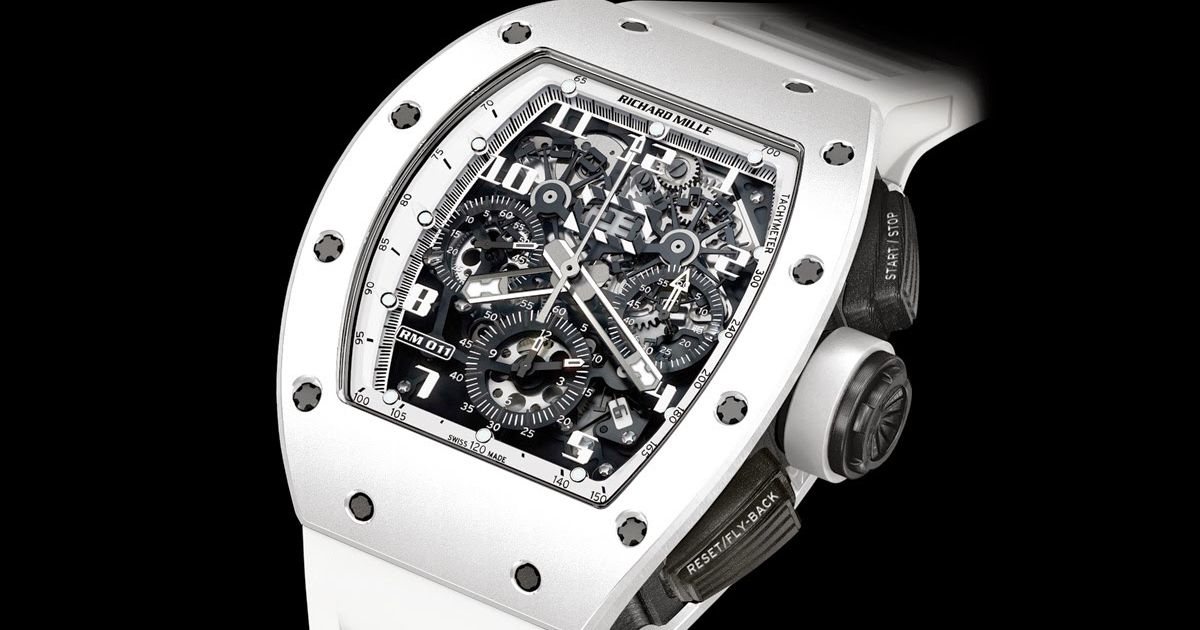
Welcome back, horology enthusiasts. Today, we’re diving deep into a contemporary legend, a watch that redefined the codes of the high-end chronograph. The Richard Mille RM 011 isn’t just a timepiece; it’s a statement, a feat of engineering, and a masterclass in material science. While its celebrity associations are well-documented, the true magic lies beneath its avant-garde exterior. For the budding watch aficionado, dissecting the RM 011 is like attending a seminar on 21st-century watchmaking.
The Philosophy – “A Racing Machine on the Wrist”
To understand the RM 011, you must first understand Richard Mille’s founding principle: to create the ultimate “racing machine for the wrist,” drawing direct inspiration from Formula 1. This goes far beyond mere aesthetics. It’s a holistic approach encompassing extreme lightness, shock resistance, ergonomics, and legibility under stress. The tonneau-shaped case isn’t just for looks; its geometry is designed to ergonomically fit the wrist while providing a rigid housing for the complex movement within. Every component, from the case to the smallest bridge, is scrutinized for its purpose, weight, and strength.
The Anatomy of a Case – A New Vocabulary
The RM 011 case is a radical departure from traditional watchmaking. It’s a multi-part construction, typically featuring a caseband (the middle section), bezel, and caseback, all secured by numerous visible screws. This “architectural” approach is key to its identity.
- Materials: Here, the RM 011 educates us on modern materials. You’ll encounter cases in Carbon TPT® or Quartz TPT®, where hundreds of layered composite sheets are heated and compressed, creating a mesmerizing woodgrain-like pattern that is incredibly strong and lightweight. There’s also NTPT® Carbon, a variation developed with North Thin Ply Technology. These aren’t just for show; they offer exceptional resistance to shocks and temperature changes, far superior to traditional metals.
- Functionality: The prominent, sculpted pushers are designed for easy operation, even with racing gloves. The crown guard is integrated into the case architecture, not an afterthought. The sapphire crystal is heavily curved, both for visual drama and to reduce glare.
The Dial – Skeletonized Legibility
The RM 011 presents an “open-worked” or skeletonized dial, but with a critical distinction: it prioritizes function-led legibility. Unlike some skeleton watches that become artistic yet confusing, the RM 011’s dial is a study in clear information hierarchy.
- Central Hands: The hours and minutes remain prominent.
- Chronograph Counters: The oversized 60-minute counter at 4 o’clock and the 12-hour counter at 6 o’clock are immediately readable.
- The Annual Calendar: This is a signature complication. Displayed via a large window at 12 o’clock (month) and a small date hand, it automatically accounts for 30 and 31-day months, only requiring correction once a year in March. It’s integrated seamlessly into the sporty layout, proving a practical complication can belong in a high-performance chassis.
- Asymmetry & Depth: The dial isn’t flat; it’s a three-dimensional landscape of appliques, satin-finished surfaces, and raised sub-dial rings, creating incredible depth and avoiding visual monotony.
The Heart – The Calibre RMAC1 Flyback Chronograph
This is where the engineering genius truly shines. The automatic calibre RMAC1, developed in collaboration with Audemars Piguet Renaud & Papi (APR&P), is a technical tour de force.
- Flyback Chronograph (Retour-en-vol): This is a crucial feature for our lesson. A standard chronograph requires three pushes to restart: stop, reset, start. A flyback allows the timing of consecutive intervals with a single push of the lower pusher. It instantly resets to zero and immediately restarts. For timing laps or any sequential event, it’s invaluable. The RM 011 executes this function with remarkable crispness.
- Architecture & Finishing: The movement is built on a titanium baseplate, chosen for its strength, lightness, and anti-magnetic properties. The finishing is functional yet exquisite: bead-blasted surfaces, micro-blasted milled sections, and polished countersinks. It’s industrial haute horlogerie. The variable-inertia balance wheel and the fast-rotating barrel (winds in just ~5 hours) ensure optimal performance and power reserve.
- Shock Protection: Notice the lack of traditional balance cock? The balance wheel is held by a spline-bridge—a single, sturdy beam fixed at both ends. This, along with the free-sprung balance, offers superior resistance to lateral and vertical shocks.
The Wearing Experience – The Ultimate Test
A watch must be worn. On the wrist, the RM 011’s radical design crystallizes into pure sense. Its lightness is startling, defying its substantial presence. The case curves snugly, eliminating “top-heaviness.” The rubber strap, with its distinctive folding clasp that integrates into the case lines, is supremely comfortable. This is a 45mm watch that wears like a much smaller piece due to its ergonomic mastery.
Conclusion: Why the RM 011 Remains an Icon
The RM 011’s iconic status isn’t about being the most expensive or the most traditional. It’s about coherence. Every single element—from the choice of graphene composites to the flyback function, from the annual calendar placement to the spline-bridge—serves the core philosophy of creating a resilient, high-performance instrument for modern life.
For the learner, it teaches invaluable lessons: that material innovation is as important as complication; that legibility is paramount, even in skeleton designs; and that true luxury lies in purpose-driven engineering. It challenged the establishment and, in doing so, created an entirely new segment. The RM 011 isn’t just a flyback chronograph; it’s the definitive blueprint for the 21st-century super-watch.